Items List
 Men Watches
 Women Watches
 Pair Watches
 Mobile Handsets
 Gift Hampers
 Home Appliances
 Below $12

Relationship

For Him
For Her
For Kids


Occasions
Birthday
Anniversary
New Born
Wedding
Rakhi

Condolence
New Year
Valentine's Day
Parent's Day
Diwali 
Friendship Day

Gift Finder

Can't find a PRODUCT or delivery DESTINATION :
Don't Worry -- Just tell Let us know your requirement & we shall try our best to arrange it for you.


 Send Flowers to Karnataka
 Send Gifts to Belgaum
 Send Gifts to Solapur
 Send Gifts to Goa
 Send Gifts to Bangalore
 Send Gifts to Hubli
 Send Gifts to Dharwad
 Send Gifts to India

 www.clickroses.com
 www.gift2belgaum.com
 www.gift2solapur.com
 www.gift2goa.com
 www.gift2bangalore.com
 www.clickhubli.com
 
About Mysore
 

Mysore is the second largest city in the Indian state of Karnataka. Mysore is the administrative seat of Mysore District, and Mysore Division. Mysore is located at 770 m above sea level at at 12.18° N 76.42° E and is 135 km from Bangalore, the state capital. The city is spread across an area of 128 square kilometres.

Mysore was the capital of the Kingdom of Mysore. The city is known for its palaces and proximity to several other places of interest like Srirangapatna and Krishna Raja Sagara Dam.

Along with Sandalwood products and crafts, Mysore is also famous for its celebration of the ten day Navaratri (Dasara) festival held every year.

Origin of Name:

According to Hindu mythology, the area around Mysore city was once the domain of the demon king Mahishasura, who grew almost invincible and wreaked havoc on the world. The Goddess Chamundeshwari, vanquished the demon after an intense ten day struggle. The Goddess is therefore also known by the name Mahishasura Mardhini (Slayer of Mahisha). The battle and the victory are commemorated by the annual nine-day Navaratri festival to this day. The name Mysore is the anglicised version of Mahishūru which is derived from Mahisha. This legend renders the temple of the Goddess Chamundeshwari, located atop Chamundi Hills in Mysore, an important place of pilgrimage.

History:

The history of Mysore is closely linked to the history of the Kingdom of Mysore. References from the times of Mahabharata and Asoka refer to Mahisha Nadu or Mahisha Mandala. References can also be found in Tamil literature about Ezimahi Nadu. The earliest documented evidence of the town is in the form of stone carvings in old Kannada(Saasanas) found in villages around Mysore, inscribed around 1021 CE. From 1499 the name Mahisūru has been recorded in inscriptions. During the rule of the Vijayanagar Empire, the Mysore kingdom served as a feudatory, gaining sovereignty after the empire fell in 1565 CE. Till the year 1610, when Srirangapatna was acquired, Mysore was the center of Wodeyar administration. It became the capital of the Kingdom of Mysore after the death of Tippu Sultan in 1799 [1].

The administrative center was shifted to Bangalore in 1831, when the British moved their garrison from Srirangapatnam (on the outskirts of Mysore) to the Bangalore Cantonment. Mysore once again became the capital of the kingdom in 1881 with the rendition of power by the British to the Wodeyars. Most present day historical landmarks, and the organisation of the city of Mysore, were inspirations of the Wodeyar kings and their Dewans. Plans for organised development of the city exist from as far back as 1904. The period between 1910-1945 is considered the most important in the modernization of the kingdom. Several industries (including a steel mill) were begun, an efficient railway system was constructed, as was a network of irrigation canals, art and culture flourished under the patronage of royalty, and the educational system was revamped.

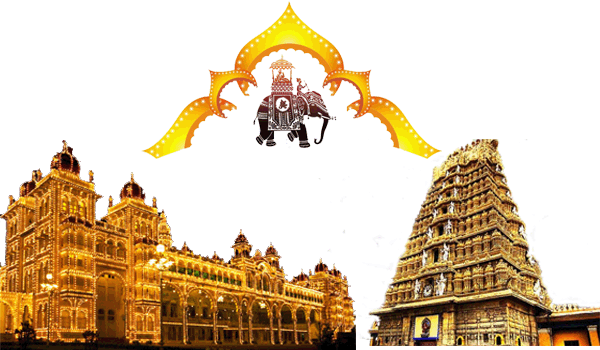
Mysore is called the City of Palaces as a result of the number of palaces situated in the city, including Amba Vilas (Main Mysore Palace), Rajendra Vilas (the summer palace, situated on the Chamundi hills) and Jayalakshmi Vilas (now in the University of Mysore premises). The main palace of Mysore was burnt down in 1897, and the present day structure was built on the same site. The palace exhibits a mixture of Dravidian, Indo-Saracenic, Roman and Oriental architectural styles. Even though the Government of Karnataka now maintains the Mysore palace, a small portion of the palace has been allocated for the erstwhile Royal family to live in. The Jayalakshmi Vilas Mansion was constructed by Sri Chamaraja Wodeyar for his daughter Jayalakshammanni. It is now a museum dedicated to folk culture. A new gallery is being added for artefacts and collections of the Wodeyars of Mysore.

Climate:

Mysore enjoys a temperate climate, with summer temperatures ranging from 21 to 34 degrees Celsius, while winter sees the temperatures dropping down to from 12 to 30 degrees Celsius. The city gets an average of 86 centimetres of rain annually, most of it during the monsoon, in the June - October period.

Economy:

Industries, including those manufacturing tyres (Vikrant Tyres), textiles (K. R. Mills, now Atlantic Mills), electronic systems (L & T), earthmoving and mechanical systems (BEML), silk (KSIC) and those producing software (Infosys, Wipro, SPI (Software Paradigms International)), along with education and tourism (centered around numerous attractions and the Dushera Festival), are significant contributors to the economy of Mysore.

Infosys has established its training center with an investment of over 65 mn$, and with a training capacity of about 4,500 people in Mysore. Wipro has its Global Service Management Center (GSMC) for serving the eastern markets here. This center also serves as a backup to Wipro's Global Command Center in Bangalore.

Mysore contributed Rs 370 crores to Karnataka's Rs 38,000 crore IT exports in 2005. There are a number of small IT companies that make a significant contribution, albeit inconspicuously (unlike the big IT companies). Efforts are being made by the current state administration to persuade IT companies to move to Mysore, to ease the infrastructure burden on Bangalore and enhance the overall development of the state.

Education and research at the University of Mysore, Defence Food Research Laboratory (DFRL), Central Food Technological Research Institute (CFTRI), Central Institute of Indian Languages (CIIL), Central Sericultural Research & Training Institute (CSRTI), Central Institute of Plastics Engineering and Technology (CIPET), All India Institute of Speech and Hearing (AIISH), Karnataka State Open University (KSOU), Regional Institute of Education, The University School of Design (Architecture) and various medical, dental, pharmacy, engineering, and science colleges contribute to the economy and academic reputation of Mysore.

Articles made of silk, ivory and sandalwood are some of the most famous products of Mysore, making significant contributions towards commerce. The divisional headquarters of Mysore Division and the Railway Station are other major employers.

The economy experienced reverses during the last few decades, as some of the major industries like Ideal Jawa (automobiles) and K. R. Mills (textiles) closed down and several people became unemployed. However some revival efforts, like those of K. R. Mills (Atlantic Mills), helped improve the situation. In recent years the software industry has grown and could expand further to become the most significant contributor.

Infrastructural improvements in progress, such as the doubling of railway tracks and the building of a four lane expressway between Mysore and Bangalore, are expected to bring significant growth to the economy of Mysore.

Transport:

State highways 17, 33, 86, 88 pass through Mysore connecting it to nearby cities. The existing four-lane road linking Mysore to Bangalore is being upgraded to a six-lane highway, thus significantly reducing the commute time. Mysore is the railway junction for the district, and rail lines connect Mysore city to Bangalore to the northeast via Mandya, the rail junction at Hassan to the northwest, and Chamarajanagar via Nanjangud to the south east. The nearest airport is at Bangalore. The Mandkalli Airport, approximately 4 miles from the city, is currently inoperative, although paragliding and, occasionally, aeroplane rides are offered at this location. A memorandum of understanding is expected to be signed by the Karnataka government and the Airports Authority of India, leading to the redesign and extension of the airport.

Mysore has intra-city, inter-city and suburban public bus transportation. Traditional means of transport available in other Indian cities like Autorickshaws and Taxis are also available. Tongas (horse drawn carriages) are also available, but usage is declining.

Culture:

Mysore Dasara
Dasara is the Nadahabba (state festival) of Karnataka. Mysore is well known for the festivities that take place during this period. Also termed as Navaratri (meaning nine-nights), it is a ten day festival usually held during the months of September and October. During this period, various cultural and religious programs highlighting the arts and culture of Karnataka and India are held. The Mysore palace is illuminated on all ten days and prominent cultural programs are held in the palace grounds. The festivities begin with a pooja performed to the Goddess Chamundeshwari atop the Chamundi Hills in the presence of the Wodeyar royal couple, high ranking officials of the State and other invitees.


Spiritual tourism
Many Mysore yoga instructors draw international students for extended yoga programs, including Venkatesh Iyengar and Pattabhi Jois. Teachers of Sanskrit, kirtan chant, Ayurveda and other yogic forms are readily available. The Sri Ganapati Sachidananda Ashram welcomes visitors, as does the Indus Valley Ayurvedic Center. In addition to traditional Hindu spiritual methods, courses are available in Osho meditation, the Art of Living, Reiki, Breema, and many other systems.

Diversity
The city is famous for its multiculturalism and diversity. Festivals like Eid ul Fitr, Eid-ul-Adha, Deepavali, Holi and Christmas are marked by members of all religious communities. There is also a Gurudwara (Sikh Temple), open to all, and maintained by the small Sikh community in Mysore.

Education:

Mysore is reputed for the quality and breadth of its academic and research institutions. A variety of research organizations conduct pioneering activity in the areas of food technology, Indian languages, Rare Earth materials, speech and hearing, sericulture, etc.. Higher education can be pursued in disciplines that range from liberal arts and humanities to law, design, management, architecture, pharmacology, dental sciences, science, medicine and engineering.

Modern education in the city had its beginnings in the foundation of the Free English School in 1833. Christian Missionaries also started several schools, imparting mainly English education, in the 19th century. The Maharaja's College was founded to impart higher education in 1864. The first High School had been established in 1858 in the kingdom, in Bangalore. Secondary education in the city initially comprised a three year course after the Eighth Grade, which was slightly different from the scheme followed by neighbouring principalities, but a uniform pattern and syllabus was implemented in the city as well as the rest of Karnataka in 1963. The current pattern of a two year Pre-University Course was introduced in 1972. The Kindergarten system of education was popular by the end of the 19th century, and was run mainly by private enterprises.

The importance of training teachers was also recognized fairly early in the 19th century. A school for training teachers was established in the city in 1860. Another was founded in 1893. Maharani's College (itself founded in 1881) began training classes for women in 1888. A Zanana School for Urdu Teachers began functioning in 1916. The faculty of Education was begun in the University of Mysore in 1952.

The National Institute of Engineering, established in 1946 in the city, was one of the first engineering colleges in the country. The Mysore Medical College, affiliated to the University, was the seventh such college in the country. Established in 1917 as the Mysore Medical School at Bangalore, it was upgraded to a college in 1924, and re-located to Mysore in 1930.

Today, academics in Mysore centres mostly around the University of Mysore. It was one of the earliest institutions of its kind in India - the first University outside British dominions in the country, and only the sixth across the country. Established in 1916, it began with four broad disciplines, Arts, Science, Technology and Medicine, and 28 subjects. Today, the University campus, called Manasagangotri (Fountainhead of the Mind), occupies around 740 acres of verdant land, and conducts post-graduate courses in over 40 disciplines. One of the libraries under its control, the Oriental Research Institute, is renowned for the discovery of a manuscript of Chanakya's Arthashastra amongst its collections.


© All Rights Reserved   Site Designed & Maintained by: Clickhubli.com